

We are all part of enormous systems. This means that, whether we like it or not, they have an enormous influence on us. And only some of us manage to influence them; the majority have to adapt.
Systemic crises, or simply crises, do not arise out of nowhere. The process takes time, sometimes a very long time — from several years to decades and even centuries. That is why many people do not notice it. Another reason for this ‘invisibility’ is that these processes almost always take place beneath the surface.
This is a traumatic example for many countries, but take earthquakes. A great deal happens underground, invisible to the human eye, to an ordinary person. Only modern scientists know about it and monitor it. That is why, for a long time, earthquakes came as a surprise to people. But not to the earth itself.
It is much the same with crises, systemic crises. The difficulty with systemic crises is that they are a mixture of several crises. The more crises merge in ecstasy at the same time and in the same place, the greater their scale, the upheaval and the synergistic effect.
Russia has entered a systemic crisis, and I suspect its scale is far greater than even the ‘boldest conjectures’.
I recently spoke to an estate agency and asked how things were going. Not very well, but the head of the agency believes that, since they have been in this market since 2000 and have survived more than one crisis, they will survive this one too… When I said that this crisis was bigger than what happened in the early 1990s… There was just one word in reply: ‘Horrific.’ The positive outlook evaporated.
No, my aim is not to frighten anyone. My aim is something else — to hint, to speak out, so that people recognise what is happening, accept it and perhaps prepare themselves mentally. Blessed are those who do not know, but they are always in shock when events unfold. It is hard for those who understand to know in advance, but they can accept it beforehand and prepare in some way.
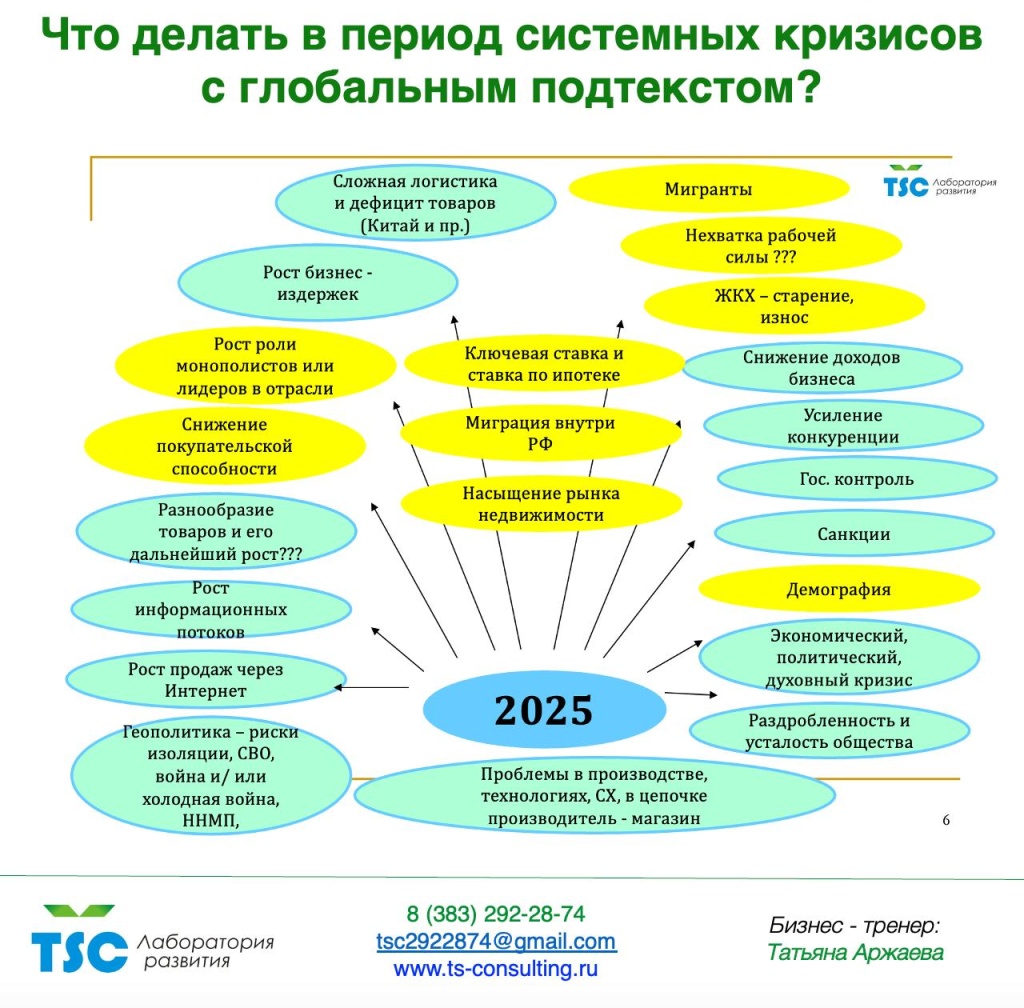
So, which crises are colliding with one another to form this extraordinary mix…
The order in which they are listed no longer matters.
A staffing crisis in business — from enormous shortages in numbers to a lack of quality.
A staffing crisis in state institutions — from enormous shortages in numbers to a lack of quality. I am not talking about officials, but about education, healthcare, law enforcement and so on. Even the official percentage shortfalls make one fear for the present and the future, and the unofficial figures will be higher.
A crisis in food production and trade. The chain from agriculture to the consumer’s table has so many unresolved problems that it would take only 1–2 little cogs to fall out for everything to grind to a halt.
The special military operation involving Ukraine and the confrontation with the West in the form of Europe, NATO and the USA, which are collectively pouring a simply incredible amount of money into this and have long-term plans for this confrontation and its intensification… The West has no desire whatsoever to end the conflict, nor could it have had any (read carefully the response to Putin’s ultimatum in January 2022) — only to intensify it and ratchet up tensions.
How long can our country hold out without consequences? Yes, there are already consequences. In fact, we are talking about a large-scale geopolitical crisis involving an enormous number of acute crises, overt crises that could become acute and hidden crises that could become acute.
But Russia also faces other geopolitical risks — in fact, the country has only 4 peaceful, friendly neighbours out of 18: Belarus, Mongolia, China and the DPRK…
The enormous number of Muslim migrants in the country, the constant incidents involving demands for privileges and exceptions, have long given grounds to speak of clear direction, a guiding hand in this matter, and the Islamisation of the country. There are several reasons for this. People from countries with weak economies (which are particularly ill-equipped for population growth) want to move somewhere better to live, and going to a neighbouring country is a shorter route. However, there is a big question about the attitude with which they come to their large neighbour. Russia is accommodating towards Islam for political reasons — the UAE, Iran and so on. Attempts not to lose ‘influence over its neighbours’, which is clearly being lost, and far too rapidly (Azerbaijan is de facto under NATO, Kazakhstan is heading the same way, and so on and so forth). There are indigenous Muslims within Russia. But Russia has no clear, coherent migration policy in the interests of the state, and despite the secular nature of the state, its implementation proves ill-defined: we need only recall Peskov’s statement that the Kremlin does not take part in discussions about hijabs. The existence of radical movements within Islam. Most migrants have little education and high birth rates, which makes them attractive to radicals (think of Crocus and Dagestan this year). Against this backdrop, there are also manifestations of nationalism among migrants (and the indigenous population too), accompanied by Russophobic sentiments.
The demographic crisis. For example, Iran’s population has tripled over the past 50 years, and Turkey’s has quadrupled over 70 years. Central Asia’s population has grown by a factor of 1.8 over the past 33 years. But in Russia there is no growth. 1989 — 147.4 million; 2023 — 146.4 million… (and these figures include those very migrants with Russian passports, so there are even fewer of us). France’s population, meanwhile, grew between 1989 and 2024 by 10 259 811 people, an increase by a factor of 1.17. Not much, of course, but you must agree that it is better than our situation. Germany is growing more slowly than France, but faster than we are. The USA — by a factor of 1.33; between 1990 and 2020 its population grew by 82 million… people. Officials and the authorities bustle about, devising various programmes and laws. But in reality, the conditions for a high birth rate simply are not there (one thing after another, not a moment’s peace). And some of the things officials and MPs sometimes spout in their speeches provoke, at the very least, public rejection and a reluctance even to think about having children. A recent example: MP Aleksandr Iltyakov distinguished himself with his remarks about a ‘baby-making organ’, to make the message sink in.
The technological crisis. This is not something people tend to talk about. Are you in the office now? Look around you: what among the things surrounding you was made entirely in Russia? Are you at home? Look around you: what among the things surrounding you was made entirely in Russia? Are you in a car? The same applies. At a production facility? The same applies: look around. Technological development requires science — powerful, strong science. And that requires education. And for that, teaching (like medicine, engineering and design engineering, for that matter) must regain its status as a noble profession (with corresponding pay). For some reason, they understand this in capitalist South Korea…
The true, genuine elite of any country consists precisely of doctors, teachers, engineers and scientists.
The housing and utilities crisis, in which the foremost concern is, of course, the state of the heating and electricity systems (hello, Chubais) — or rather, their failure to stand up. The breakdowns of winter 2023–24 were neither the last nor the biggest.
The multitude of sanctions. Yes, we are holding out for now, but that does not mean there are no consequences. And this cannot go on for ever. But how effective and timely are our retaliatory sanctions? There seems to be silence on that…
Meanwhile, world sport and culture have become politicised, and the UN… has simply been told where to go (hello, Israel, which said it openly). Again, this touches on the global undercurrents.
Accelerating inflation, actions by the Central Bank that raise questions about their effectiveness and about whom the Bank answers to, and, sad as it may be, we have entered an economic crisis. People’s living standards have been falling for a long time. Let me give an example: my youngest child developed an ENT condition. The medication for 6 days of treatment cost 5 400 roubles. For, say, a primary school teacher or nursery teacher earning 30 000 - 35 000 roubles, that is… a sixth or a seventh of their income. And children may fall ill more often than once a month, or for longer than 1 week. For many pensioners, meanwhile, that is a third of their income. A slowdown has already occurred across a whole range of sectors. Mass bankruptcies lie ahead, along with the unemployment that many businesses and HR departments have long been waiting for (when those that survive can easily find staff), but none of this will happen all that quickly yet, although it is almost inevitable. But the economic crisis manifests itself in more than this. Here, too, there is a whole complex of signs, factors and so on.
The political crisis. The issue is not the absence of a credible opposition. It is the enormous number of corruption scandals, beside which the fake stories put out by foreign agents pale into insignificance. It is the way some officials and MPs manage to blurt out things in public that defy description. But most importantly, Belousov’s appeal (‘You may make mistakes, but you must not lie’) has gone unheard. I recently spoke about management competencies and team building at an event for people working in culture. A participant asked: ‘What about moral and ethical qualities, values? Is there a place for them in management?’ I answered (there is a place for them, and a very substantial one), but the organisers interrupted me after I said: ‘For almost 40 years, we as a state have focused on profit; it has been our overriding priority in everything. Will this have consequences in various areas?’ Until officials and authorities at every level, and MPs, begin honestly to acknowledge their mistakes in governing the state, nothing will change. Until they begin to serve Russia and its people rather than the golden calf, nothing will change. Until they are prepared to stop suppressing, concealing and distorting information, nothing will change. It is time to stop trying to wave the clouds away and honestly acknowledge our mistakes, because only then can we put them right. But that requires genuine courage and real patriotism, not an imitation of it.
A crisis in the practical management of the country, encompassing some of those already mentioned and a host of sectoral crises. We have spent too much time on politics. Or rather, playing politics. And playing at economics too. A country is like a village (only bigger). In a village, you need to be a capable practical manager first, an economist second and a politician only after that. But our pyramid is upside down. In other words, there is also a crisis in setting priorities.
The gathering crisis of trust in the authorities. Yes, we are told about Putin’s high approval ratings. But… in some cases, a high rating is a sickly-sweet rating, too sugary. High sugar levels are a sign of problems and future damage in the body. There are reports that Saddam Hussein had a 100% approval rating in 2002. How things ended for him, and for the country, is well known. Too much sugar is harmful. A reasonable approval rating for a popular president is 40–60%. This means that there is trust in the authorities, but that people also retain a critical view of their actions, which is necessary for the healthy development of society and the state. This is a good balance. Upsetting that balance always carries consequences. High ratings may conceal manipulation, fear among respondents or a sense of hopelessness. High ratings also make the authorities passive, which leads to problems. It is also worth remembering the folk saying: it is only one step from love to hate. Great love can turn into great hatred in an instant. The Bush family — junior and senior — and Truman. And Kennedy, who had a high approval rating, was assassinated.
The spiritual crisis. In autumn 1917, a revolution took place, bringing a change in the political and economic order, as well as the ideological order. But in the late 1980s and early 1990s, while the political and economic system changed, the ideology was simply destroyed, and nothing was ‘offered’ in its place. In practice, this led to something very simple: ‘profit, money’ (preferably easily obtained) became our be-all and end-all, everywhere and always. Yes, in the 2010s many businesses began actively working on their ‘mission’. But their annual reports never said a word about mission or values, whereas financial figures were always there. Yes, money matters in a capitalist country. A great deal. However, money and commodity–money relations are only part of the social system, not its pinnacle, especially when it comes to the effective development of a state without dependence on anyone else. We are reaping the fruits of a prolonged absence of a moral and ethical dimension in what the media write, what bloggers promote, how children and teenagers behave, what happens on the streets, in show business and culture, and what senior executives and oligarchs live and breathe.
May the Orthodox Church forgive me, but if its representatives become so concerned about former prosecutor Natalya Poklonskaya’s adherence to neo-paganism and her witch-like outfits in photographs that they call it dark forces and Satanism… I want to ask: are the leaders of the Orthodox Church sure that all its representatives and followers are role models and — may they forgive my sarcasm — that a halo shines above every one of their heads? Of course not. So perhaps it would be better to attend to their own internal affairs, become better, kinder, more merciful and more loving, and people would gravitate towards them of their own accord rather than draw away. And Poklonskaya will somehow work out for herself which path to take to God and what to wear.
Yes, traditional and family values have become a theme here. But which values, specifically? Some specifics are given, but not fully (the Presidential Decree of 9 November 2022). And most importantly… why not spiritual values? Why not moral and ethical ones? What does dignity mean? High moral ideals? The priority of the spiritual (what exactly is meant by that)? What is continuity between generations? What is understood by each value in the Decree? What behaviour is considered exemplary within a particular value? How will we know whether a value is being upheld or not — from a person’s words or deeds (which ones)?
And most importantly, who should be the first to become a role model? A genuine example in practice, not just packaging… Who will set an example? Those in authority, especially those with foreign citizenship and children abroad? Oligarchs with wives and mistresses, and their privileged, spoilt children? Those very MPs who sometimes say things that leave the public in shock?
The consequence of all this is a disorientated and fragmented society. The special military operation cannot solve the problem of uniting society. In fact, no war solves that problem. Cause and effect, the horse and the cart. The unity of the overwhelming majority of society during the Great Patriotic War, for example, was based not on Germany’s attack on the USSR, but on the ideology that had taken shape and become established by that time. That is precisely why consolidation was almost instantaneous (in historical terms). And what happened here in 2022, especially when mobilisation was announced in the autumn? The horse must be in front of the cart; then everything moves. Of course, you can put them side by side… The horse will move, but the cart will stay where it is.
And ahead lie strikes on Russia with long-range weapons (there will be no avoiding this), with Putin promising to regard this as direct participation in the war, while the DPRK has announced full military preparations…
Tatyana Arzhaeva